Is Le Creuset Worth It? An Honest Look at the Price (2026)
By Claire Whitmore. Last updated October 23, 2026.
Disclosure: some links on this page are affiliate links, including Amazon links. If you buy through them we may earn a commission at no extra cost to you. It doesn’t change what we recommend. Details are in our affiliate disclosure.
Le Creuset is one of the few kitchen brands people buy for the name and keep for the performance. A single round Dutch oven costs several hundred dollars, more than an entire set of budget cookware, and there are now plenty of enameled cast-iron pots that look almost identical for a fraction of the price. So the question is fair: is Le Creuset actually worth it, or are you paying for a logo and a color chart?
We approached that question the way a careful buyer would. We read the long-term testing from Serious Eats, Bon Appétit and Good Housekeeping, compared Le Creuset’s specifications and warranty with Staub and with cheaper enameled cast iron, and looked at what reviewers say about how these pots age over years and decades. We haven’t run our own lab tests; where a figure appears, we credit the source.
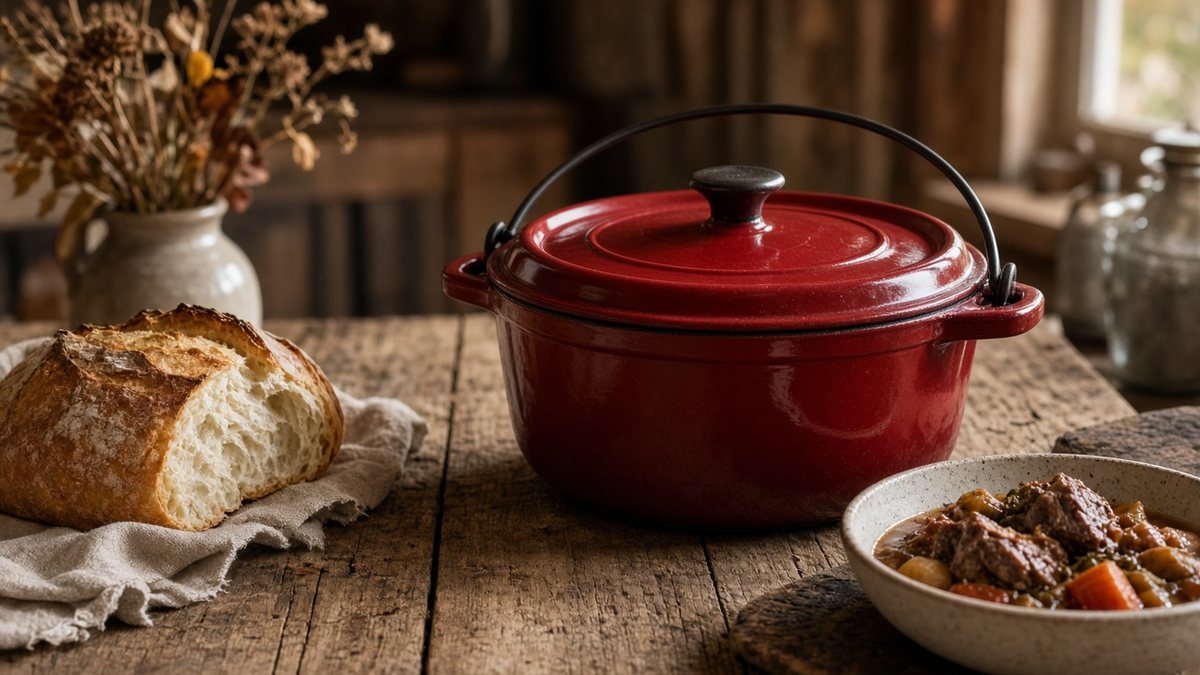
The short answer: for most people who cook often, yes, one Le Creuset piece, usually the 5.5-quart round Dutch oven, is worth it. You’re paying for a lighter, better-balanced pot, a durable light enamel, French manufacturing, a limited lifetime warranty and a proven record of lasting decades. A full Le Creuset set usually isn’t worth it, and for occasional cooks a well-reviewed budget Dutch oven will do the job.
Our picks at a glance
| Question | Le Creuset | What it means for you |
|---|---|---|
| Where it’s made | Enameled cast iron made in Fresnoy-le-Grand, France (Bon Appétit) | Consistent quality control |
| Weight, 5.5-qt round | 11.4 lb (Serious Eats) to 11.6 lb (Bon Appétit) | Lighter than Staub and many budget pots |
| Interior | Smooth, light sand-colored enamel | Easier to see browning; shows wear over time |
| Max oven temperature | 500°F (Serious Eats) | Fine for bread with a metal knob |
| Warranty | Limited lifetime | Covers manufacturing defects, not misuse |
| Typical price, 5.5-qt | Serious Eats listed $455 when tested | Expensive, but often discounted |
What you’re actually paying for
It’s easy to assume a Le Creuset is just cast iron with pretty paint. But the details that separate it from cheaper pots are the ones you notice over years of use, not in the store.
1. A pot that’s easier to use
Enameled cast iron is heavy by nature, and weight matters every time you lift a pot of stew in and out of the oven. Serious Eats weighed the Le Creuset 5.5-quart round at 11.4 pounds, against 13.2 pounds for Staub’s equivalent and 13.6 pounds for Made In’s. In the same testing, some budget pots were heavier still: a KitchenAid enameled Dutch oven weighed 15.6 pounds and a FIREUP model 17 pounds. Serious Eats said the Le Creuset “hit the sweet spot” with wide looped handles and manageable weight. Bon Appétit made the same point, noting Le Creuset’s thinner cast iron is still thick enough for wonderful heat retention.
That lighter weight isn’t a small thing. A pot you can lift comfortably is a pot you’ll use on a Tuesday night, not just on holidays.
2. Enamel that lasts
The enamel is where cheap Dutch ovens most often fail: it chips, crazes or wears through, and once that happens the pot is on borrowed time. Le Creuset’s reputation rests on enamel that holds up. Bon Appétit notes that, from experience with inherited pieces, the chip-resistant enamel can last a lifetime with proper care, and Serious Eats’ tester said her parents’ pot is over thirty years old and still hasn’t chipped. Serious Eats editors report owning and using theirs for years, some inherited, with no damage or wear.
We can’t promise a budget pot will chip, and many are fine for years. But a long, documented record of durability is exactly what you’re paying for with Le Creuset.
3. A light interior that helps you cook
Le Creuset’s sand-colored interior lets you see the fond, the browned bits that build flavor, so you can stop before it burns. Bon Appétit found it produced a beautiful, even sear and called the light enamel an advantage for monitoring browning. The trade-off, which Bon Appétit is upfront about, is that light enamel gradually discolors with frequent use, and scrubbing it with abrasives to keep it pristine can wear the enamel. If stains bother you, Staub’s black interior hides them; see our Le Creuset vs Staub comparison.
4. Shape and design that work
Bon Appétit notes Le Creuset Dutch ovens typically have a wider cooking surface and lower sides, which gives more room to sear meat in batches before braising, the core Dutch oven job. Le Creuset now offers metal knobs, a meaningful upgrade: Bon Appétit warns the old black phenolic knobs could melt if you baked bread at around 450°F. You can also swap knobs; a Serious Eats editor bought a brass one for her pot.
5. A warranty and a resale market
Le Creuset’s enameled cast iron carries a limited lifetime warranty against manufacturing defects. Le Creuset pieces also hold their value remarkably well. Vintage and secondhand pots are actively traded, which tells you something about how long they last and how much people want them.
Where Le Creuset isn’t worth it
- Full sets. Most cooks use one Dutch oven constantly and the rest of a set rarely. Buy one great piece and pair it with stainless; see our luxury cookware sets guide.
- Tiny pieces at big prices. Mini cocottes and small specialty items are lovely gifts but poor value for cooking.
- Occasional cooks. If you braise twice a year, a well-reviewed budget enameled Dutch oven will be fine.
- People who want a stain-free interior. Light enamel discolors with use. Consider Staub.
- Full-price purchases. Le Creuset is discounted regularly. Paying list price is rarely necessary.

Le Creuset vs the alternatives
1. Le Creuset Signature 5.5-Quart Round Dutch Oven: the one to buy
Best for: anyone who cooks soups, stews, braises or bread for two to six people.
This is the piece reviewers recommend more than any other. Serious Eats found it heated quickly, seared pork shoulder to a crusty golden brown and braised it down to silky ribbons. Its specs per Serious Eats: an 8-inch cooking surface, induction compatibility, a 500°F max heat, a limited lifetime warranty, and dishwasher-safe although hand washing is recommended. Other sizes run from 2 to 13.75 quarts.
If you cook for one or two, the 4.5-quart is lighter and plenty; for big families, the 7.25-quart.
Pros
- Light for its class, with great handles
- Proven longevity
- Light interior aids browning
Cons
- Expensive
- Light enamel discolors over time
2. Staub Round Cocotte: the French alternative
Best for: cooks who want maximum heat retention and a stain-hiding interior.
Staub is Le Creuset’s closest rival and usually costs a little less. Its black matte interior hides wear, and its self-basting lid measurably redistributes condensation in side-by-side tests by Prudent Reviews. It’s heavier, at 13.2 pounds in Serious Eats’ weighing.
Pros
- Self-basting lid
- Dark, forgiving interior
- Often slightly cheaper
Cons
- Heavier
- Smaller handles
3. Made In Enameled Dutch Oven: the direct-to-consumer option
Best for: buyers who want a premium enameled pot from a newer brand.
Made In’s round enameled Dutch oven was part of Serious Eats’ testing at 13.6 pounds. It sells direct, often for less than Le Creuset. It lacks Le Creuset’s decades-long track record, which is the main thing you give up.
Pros
- Often cheaper
- Well-made modern design
Cons
- Heavier than Le Creuset
- Shorter track record
4. Emile Henry Sublime: the lightweight ceramic option
Best for: cooks who find cast iron too heavy.
Serious Eats weighed Emile Henry’s Sublime French ceramic Dutch oven at just 7.8 pounds, far lighter than any cast iron. Ceramic behaves differently from cast iron, so read the maker’s guidance on stovetop use and heat.
Pros
- Very light
- French-made ceramic
Cons
- Different heat behavior from cast iron
- Ceramic can crack if mishandled
5. A well-reviewed budget enameled Dutch oven
Best for: occasional cooks and first-time buyers.
Plenty of inexpensive enameled pots cook well. Many are heavier and their enamel has less of a long-term record, so check recent reviews for chipping complaints and look at weight before you buy. In Serious Eats’ table, budget options ranged from about 13 to 17 pounds.
Pros
- Much cheaper
- Good enough for occasional use
Cons
- Often heavier
- Enamel durability less proven
How to make a Le Creuset last a lifetime
- Heat gradually. Start on low to medium heat; enameled cast iron holds heat so well you rarely need high.
- Use a little fat before searing and let the pot preheat.
- Avoid metal utensils that scrape. Wood and silicone protect the enamel.
- Clean gently. Soak stuck food in warm water; use a non-abrasive cleaner for stains. Bon Appétit warns abrasive cleaners can wear the enamel.
- Don’t shock it. Let a hot pot cool before washing in cold water.
- Upgrade the knob for bread. Use a metal knob for high-heat baking.
How to buy Le Creuset for less
Le Creuset is rarely worth buying at full price. The brand and major retailers discount it around Black Friday and Cyber Monday (November 27 and 30, 2026) and during seasonal sales, and some colors are discounted when they’re being retired. Le Creuset outlet stores sell slightly imperfect pieces at lower prices; cosmetic flaws don’t affect cooking. Secondhand pots in good condition can also be excellent value: check the interior enamel for chips and the rim for damage before you buy.
Is Le Creuset worth it as a gift?
Very often, yes. It’s one of the few gifts that’s both practical and heirloom-quality, and it’s beautiful enough to serve from. Check what the recipient already owns and which colors they like. Our gifts for home cooks and gifts for her guides cover how to choose.
The cost-per-use argument
A pot used once a week for twenty years is used about a thousand times. Even at full price, that works out to well under a dollar a use, and less if you buy on sale. A cheaper pot that chips after five years and needs replacing costs less upfront but not necessarily less over time. That’s the real case for Le Creuset: not that it’s the only good Dutch oven, but that it’s one you’re unlikely to need to replace.
Who should buy Le Creuset, in one list
- Buy it if you cook at home several times a week, braise or bake bread, want a pot that’s comfortable to lift, and plan to keep it for decades.
- Consider Staub instead if you want a darker interior that hides stains and don’t mind extra weight.
- Save your money if you rarely cook, need a pot for a single recipe, or are furnishing a temporary kitchen.
- Buy secondhand if you’re comfortable inspecting enamel and want heirloom quality for less.
FAQ
Is Le Creuset really better than cheaper Dutch ovens?
It’s typically lighter, with excellent enamel and a long track record of durability. Many cheaper pots cook well but are heavier and less proven over decades.
Is Le Creuset worth it over Staub?
Neither is objectively better. Le Creuset is lighter with a light interior and more colors; Staub is heavier with a self-basting lid and black interior.
What size Le Creuset should I buy first?
The 5.5-quart round suits most households. Choose 4.5 quarts for one or two people and 7.25 quarts for large families.
Does Le Creuset chip?
It can if dropped, banged or overheated empty, but reviewers report decades-old pots without chips when cared for properly.
Can Le Creuset go in the dishwasher?
Serious Eats lists the Dutch oven as dishwasher safe but recommends hand washing to protect the enamel.
Is Le Creuset still made in France?
Bon Appétit reports all Le Creuset enameled cast iron, including Dutch ovens, is made in Fresnoy-le-Grand, France. Some other Le Creuset products are made elsewhere.
The bottom line
Le Creuset is worth it if you cook regularly and buy the right piece: a 5.5-quart round Dutch oven, ideally on sale. You get a lighter, well-designed pot with durable enamel and a lifetime warranty that is likely to outlast you. Skip full sets and tiny specialty pieces, and if you cook only occasionally, save your money with a well-reviewed budget pot.