The Best Mandoline Slicers for 2026: Sharp, Precise and Safer Picks
By Claire Whitmore. Last updated October 2026.
Disclosure: some links on this page are affiliate links, including Amazon links. If you buy through them we may earn a commission at no extra cost to you. It doesn’t change what we recommend. Details are in our affiliate disclosure.
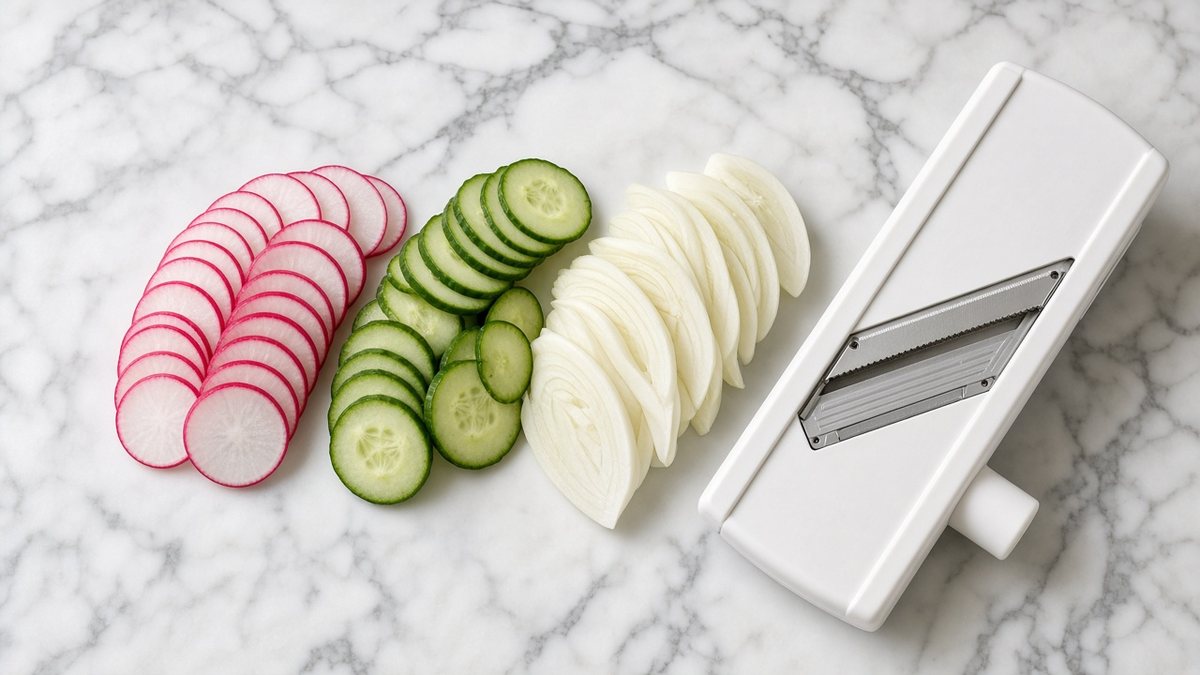
A mandoline does what even skilled knife work struggles with: paper-thin, perfectly even slices in seconds. It’s the secret to restaurant-style potato gratins, crisp shaved fennel salads, homemade chips and elegant garnishes. It’s also one of the most intimidating tools in the kitchen, so choosing a sharp, stable, simple model and using it safely matters.
This guide combines two independent tests. Serious Eats tested 10 mandolines on potatoes, tomatoes and citrus, judging sharpness, thickness control, stability and safety features. The Spruce Eats tested a lineup that includes professional French-style models and multi-blade slicers. We haven’t tested these mandolines ourselves.
Quick answer: the inexpensive OXO Good Grips V-Blade has been Serious Eats’ top pick for years. Serious cooks should get a Benriner, the Japanese workhorse found in professional kitchens and The Spruce Eats’ best overall in its Jumbo size. For small jobs, the Joseph Joseph handheld; for maximum safety, the Dash Safe Slice. Whatever you buy, add a cut-resistant glove.
Our picks at a glance
| Mandoline | Style | Thickness control | Source | Best for |
|---|---|---|---|---|
| OXO Good Grips V-Blade | Kickstand V-blade | 4 marked settings | Serious Eats: best for most people | Value, fries |
| Benriner (standard and Jumbo) | Japanese | Variable dial | Serious Eats: best for serious cooks; The Spruce Eats: best overall (Jumbo) | Precision |
| Joseph Joseph Multi-Grip | Handheld | 3 settings | Serious Eats: best handheld | Small jobs, storage |
| Dash Safe Slice | Chute | Dial | Serious Eats: best safety | Nervous users |
| Mueller Austria Multi Blade | Wide platform | Many presets | Serious Eats: best for large produce | Cabbage, squash |
| Bron Coucke Original | French stainless | Variable | The Spruce Eats: best professional | Heavy-duty use |
| OXO Good Grips Chef’s 2.0 | Multi-blade | 21 settings, 1–9 mm | The Spruce Eats: safest | Versatility |
| Cuisinart V-Blade | V-blade | Labeled presets | Serious Eats: best for beginners | First mandoline |
What the testing revealed
Serious Eats’ biggest finding is that blade sharpness matters more than anything. Sharp blades slice potatoes, tomatoes and citrus cleanly with minimal pressure, and they’re safer because you push less. Price didn’t predict sharpness; several sub-$20 mandolines beat pricier ones. And V-shaped blades, often marketed as an upgrade, made no meaningful difference over angled blades when the blade was sharp.
Simplicity also proved safer. Models with many attachments, storage compartments and elaborate setup kept hands near exposed blades longer. Continuously adjustable thickness dials gave more real-world control than presets, though labeled presets suit cooks who want quick, consistent results.
The best mandolines
1. OXO Good Grips V-Blade Mandoline Slicer: best for most people
Best for: home cooks who want an easy, affordable mandoline.
Serious Eats’ longtime favorite has a wicked-sharp blade that offers little resistance and even cut clean French fries, which others struggled with. Four clearly marked thickness settings in millimeters and inches change with a turn of a dial, and a fold-out kickstand works over a board or bowl. Swapping the underside blades is fiddly, and four settings limit fine-tuning.
Pros
- Very sharp
- Clear settings
- Kickstand
- Inexpensive
Cons
- Tricky blade swaps
- Only four thicknesses
2. Benriner Mandoline Slicer: best for serious cooks
Best for: enthusiasts and anyone who wants professional precision.
Serious Eats calls this Japanese mandoline a classic workhorse with sharp, handcrafted stainless blades and a smooth dial from wafer-thin, translucent slices to chunkier cuts. Benriner blades are removable, so they can be replaced or sharpened, a feature pro cooks love. Julienne attachments require reading the manual, the standard model is narrow for large vegetables, and there’s no blade storage.
The Spruce Eats’ best overall is the Benriner Jumbo, with a 6.5-inch-wide cutting surface and large stainless blade for big potatoes; its thickness knob has no markings, so you’ll calibrate by eye.
Pros
- Professional precision
- Replaceable, sharpenable blades
- Variable thickness
Cons
- Narrow standard size
- Unmarked dial
3. Joseph Joseph Multi-Grip Handheld Mandoline: best handheld
Best for: small kitchens and occasional use.
Serious Eats liked its sharp blade, a guard that grips food securely without gouging, an ergonomic handle and non-slip edges that make slicing feel controlled and low-stress. It stores easily but has only three fixed thicknesses and less stability than full-size models.
Pros
- Simple, compact
- Effective guard
Cons
- Three settings only
- Less stable
4. Dash Safe Slice Mandoline: best for safety
Best for: cooks nervous about blades.
You load food into a chute, press a plastic insert against it and pump the blade down, making it practically impossible to cut yourself, according to Serious Eats. A dial sets thickness. The chute is only about three square inches, so large items must be cut down, and cleaning takes effort despite the included brush.
Pros
- Nearly cut-proof
- Easy to use
Cons
- Small chute
- Harder to clean
5. Bron Coucke Original Stainless Steel Mandoline: best professional
Best for: heavy-duty home cooks who want the classic French tool.
Made by the company The Spruce Eats credits with creating the original mandoline, this large, well-built stainless unit makes straight, wavy and julienne cuts from paper-thin to half an inch, with more julienne blades sold separately and a stainless hand guard. There’s a learning curve; instructions are vague and adjustment levers start stiff.
Pros
- Heavy-duty stainless
- Classic French design
- Multiple cuts
Cons
- Learning curve
- Bulky
6. OXO Good Grips Chef’s Mandoline 2.0: most versatile
Best for: cooks who want many cuts in one tool.
The Spruce Eats’ pick for safe cutting offers straight, waffle, wavy, julienne and French fry cuts, with 21 thicknesses from 1 to 9 millimeters in half-millimeter steps, and a hand protector that held food snugly. It’s bulkier than handheld models. Serious Eats’ broader caution applies: more attachments mean more blade handling, so store and swap carefully.
Pros
- 21 thickness settings
- Many cut styles
- Stable
Cons
- Bulky
- More parts
Other good options
For big produce like cabbage and squash, Serious Eats recommends the Mueller Austria Multi Blade, with an ultra-wide surface and very thin slicing, though it’s bulky with a fixed kickstand and no in-between settings. For first-timers, the Cuisinart V-Blade strips the tool down to essentials with clear, accurate settings, though julienne has only one width.
How to use a mandoline safely
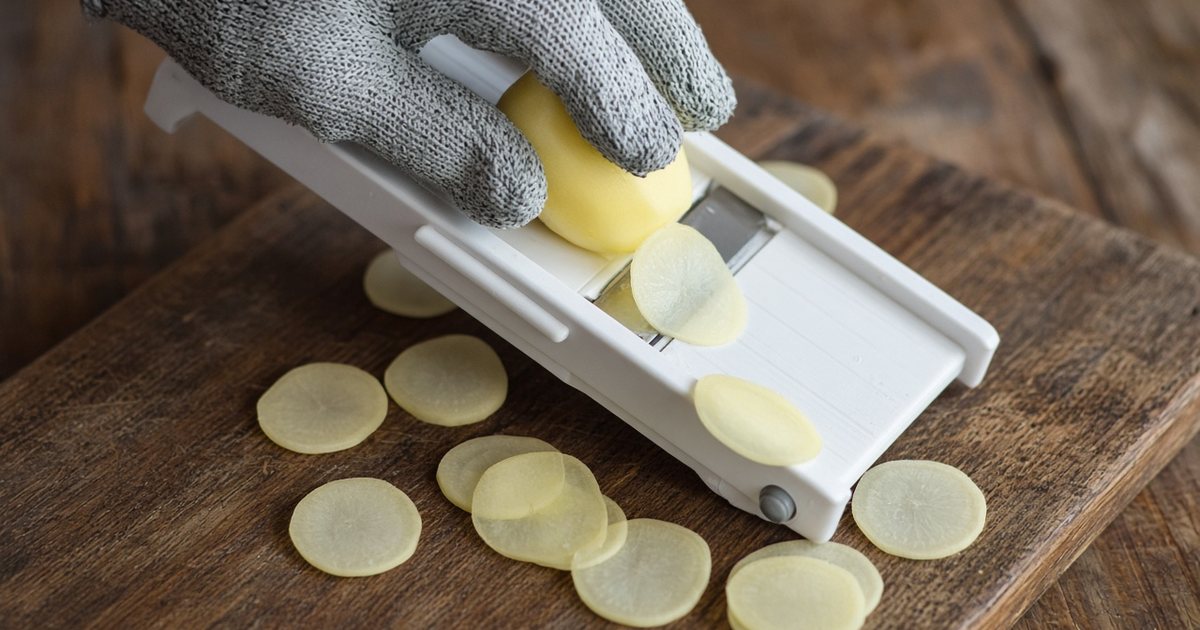
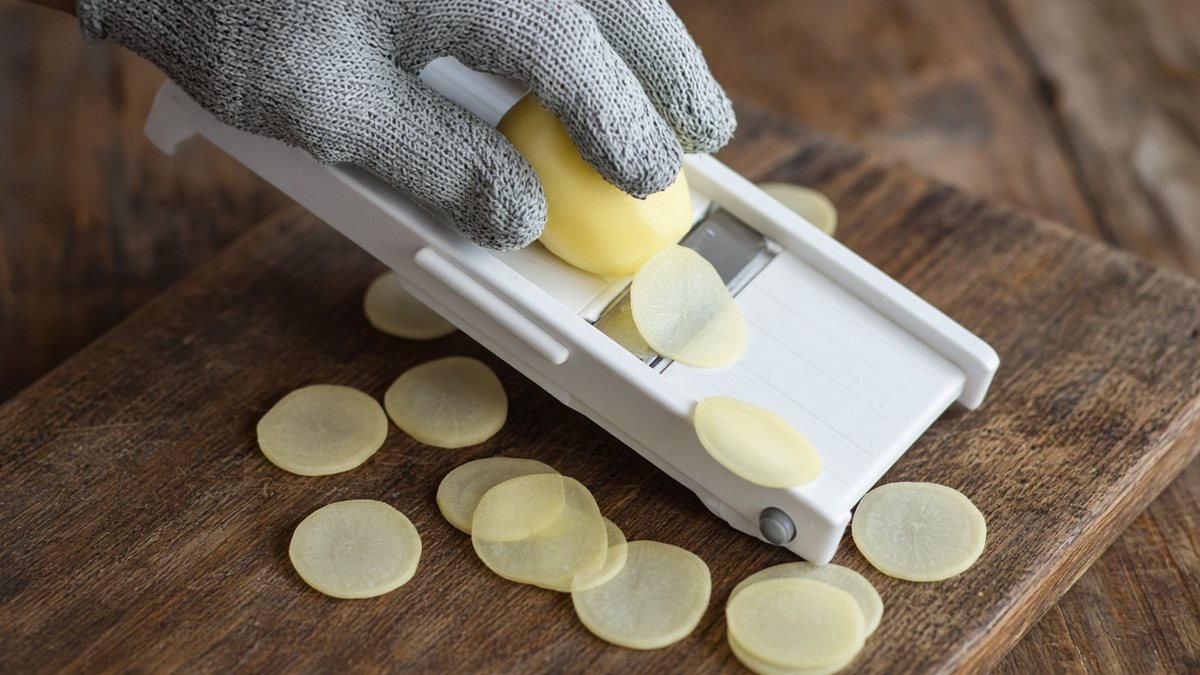
- Wear a cut-resistant glove. Serious Eats found most plastic hand guards leave a lot to be desired and relied on gloves for safety and dexterity.
- Keep the blade sharp; dull blades need more force and slip.
- Set it on a stable, dry surface and slice with steady, even strokes.
- Stop before the food gets too small; use the end for stock or a knife.
- Clean blades carefully with a brush, never a sponge pulled along the edge, and store with guards on.
What to look for
- Sharpness: the single most important factor.
- Thickness adjustment: variable dials for control; labeled presets for simplicity.
- Stability: a kickstand or non-slip feet.
- Width: wider platforms handle large potatoes and cabbage.
- Simplicity: fewer attachments mean less blade handling.
- Replaceable blades: Benriner’s can be swapped or sharpened.
FAQ
Are mandolines dangerous?
Serious Eats says no more than a knife if you handle them carefully and wear a cut-resistant glove.
Can you sharpen a mandoline blade?
Usually not; most blades aren’t removable. Benriner’s are, so they can be sharpened or replaced.
Is a food processor a substitute?
A food processor slices large quantities fast, but a mandoline gives thinner, more precise slices.
Does a V-shaped blade work better?
Serious Eats saw no meaningful difference when blades were equally sharp.
The bottom line
Buy the OXO Good Grips V-Blade for easy, sharp slicing at a low price, a Benriner for professional precision, and a cut-resistant glove either way. Pair it with a good cutting board and chef’s knife for complete prep.